Summarized on 2025-08-22
•
At three in the morning, a drunk 19&h;year&h;old male engages a 51&h;year&h;old prostitute for a 30&h;minute session. After the woman tells him that his time has expired, he angrily responds that he hasn't finished (ejaculated) yet and punches her in the face multiple times, resulting in “significant” injuries. Two hours later, he accosts a 66&h;year&h;old woman who is on her morning walk and rapes or attempts to rape her three times—once with fingers in vagina, once with penis in vagina (just an attempt since he failed to achieve an erection), and once with penis in mouth. He also inflicts severe injuries on the 66&h;year&h;old (dislocated shoulder, broken jaw, fractured eye socket, and broken nose). Some hours later, he is arrested, makes “partial admissions” to the police, and expresses “genuine remorse”.
•
The 19&h;year&h;old pleads guilty. Before the sentencing judge, the prosecutor suggests a total sentence of 14 years—3 years for the assault on the 51&h;year&h;old, and 10–14 years in total for the attempted and actual rapes and grievous bodily harm on the 66&h;year&h;old. The defense accepts that a range of 10–14 years is appropriate for the second set of offenses, and asks for a total sentence at the low end of that range. The judge imposes a total sentence of 13.5 years (with the possibility of parole after 10.8 years)—1.5 years for the assault, consecutive with concurrent sentences of 12 years for each actual or attempted rape and 6 years for the grievous bodily harm.
It is critical, as is required, that a sentence be just and appropriate, and not too crushing and disproportionate. What I have sought to do is ameliorate the sentences so that the overall sentence is just and appropriate. The likely overall sentence would have been, I think, about 16 years; that is, the sentence for count 1, in my view, is likely to have been over two years, and was likely to be over 13 years for your sexual offending, coupled with the violence.
•
The appeals panel reverses. In this case, the offender was only 19 years old, had no criminal history, had a disadvantaged background (his mother committed suicide when he was 13, and he lived unhappily with his grandmother afterward; he was exposed to excessive drinking and violence in his childhood; he started drinking at age 15), has expressed remorse, and has been out on bail for 16 months without reoffending. In the context of both the crimes and the offender&a;s background, the sentence imposed was “manifestly excessive”.
The case of R. v. Wark, in which the offender was resentenced, on appeal, to 12 years&a; imprisonment, supports the view that 12 years was too high in this case. The offender in Wark was 51 years old, with a limited criminal history of minor drug offending. He too had a problem with alcohol and had been drinking in the lead up to the offending, which started at about 1 AM one Saturday morning. The complainant, a woman in her 30s, [suffered one assault while armed, one assault with intent to rape, one deprivation of liberty, five actual rapes, and one attempted rape]. Both by reference to the circumstances of the offending (which involved a far more prolonged series of violent and degrading sexual assaults) and the offender, Wark is a more serious case.
The panel resentences the offender to 11 years (with the possibility of parole after 8.8 years)—1 year for the assault, consecutive with concurrent sentences of 10 years for each actual rape, 5 years for the attempted rape, and 5 years for the grievous bodily injury.
•
One judge on the panel dissents. She would impose a total sentence of 10.5 years (with the possibility of parole after 8.4 years)—1.5 years for the assault, consecutive with 9 years for the oral rape, and no further penalty for the other crimes.
It seems to me that a comparison with the offending in Wark and the offending in the present case shows that the primary judge&a;s starting point of perhaps 16 years for the total of the appellant&a;s offending was significantly too high. Serious though it was, the appellant&a;s offending was objectively much less than Wark&a;s offending. Not only was the starting point too high but, again in comparison with Wark, a reduction from 16 years to 13 and a half years in the present case was an insufficient reduction to reflect a guilty plea. Significantly, the primary judge in this case needed to mitigate the sentence he imposed to reflect a guilty plea, and also to reflect the fact that the appellant was a young man with no criminal history (Wark was a mature man). The appellant&a;s youth and lack of criminal history bore upon his prospects of rehabilitation. His youth also bore upon the primary judge&a;s consideration of totality. That is, in considering what might be a crushing sentence, the primary judge was obliged to consider the appellant&a;s youth.
…
The period of nine years is inflated to allow for the criminality of all the offending against complainant 2.
(The judges don&a;t mention it, but obviously any 19&h;year&h;old male who would choose to hire a 51&h;year&h;old prostitute also has a severe mental disability that warrants special sentencing treatment.)
Summarized on 2026-07-24
Year 1993
A 51&h;year&h;old divorced immigrant from Japan works as an interpreter (and later the general manager) at a golf club. She enters into a close friendship with a 25&h;year&h;old chef at the same club.
Year 2003
The golf club is sold to a new owner (and eventually is redeveloped as housing). The woman (age 61) retires. Her friendship with the man (age 35) continues.
Year 2023
The woman (age 81) suffers from delusions and temporarily is committed to a mental clinic. The man (age 55) visits her while she is committed, and after she is released she begins to rely on him more. He hires housekeepers for her, finds lawyers for her, drives her to medical and legal appointments, et cetera.
Year 2024
The woman gives to the man power of attorney, transfers ownership of her house to him, and writes a new will giving 60 percent of her estate to him and 20 percent to each of her two sisters (who still live in Japan).
Year 2024, Later
The woman&a;s sister and niece come from Japan to visit her for the first time in years. Upon discovering the situation, they try to persuade her to return to Japan, but she refuses. They file a lawsuit, (1) accusing the man of exerting undue influence over the woman, and (2) seeking guardianship over her.
Year 2026
The trial judge finds that the woman now is incapacitated, but also finds that the man did not exert undue influence over her, and awards to him guardianship over her, rejecting the claims of her Japanese relatives. In particular, when the woman visited several lawyers in year 2024, they all were suspicious of the man, but after interrogating the woman they all were convinced that she was not incapacitated or unduly influenced at that time.
Summarized on 2026-08-28
•
New Jerseyans may remember the controversy over Atilis Gym, which attempted to remained open during the coronavirus pandemic in defiance of government restrictions. Apparently, the gym&a;s owner hired somebody to ghostwrite his autobiography, and then sued her, claiming (among other things) that she fraudulently held herself out as an experienced ghostwriter and that her draft was unsatisfactory and he had to rewrite it himself. The ghostwriter countersued, claiming that her draft was perfectly fine and the gym owner was falsely holding it out as his own work.
•
The trial judge now generally has sided with the ghostwriter. (1) Neither party breached the contract. (2) Even assuming that the ghostwriter falsely held herself out as experienced (and the judge finds that she did not), this alleged lie cannot be linked to any damages suffered by the gym owner, since he unilaterally canceled the project before the ghostwriter delivered a final draft and received payment from him. (3) While the gym owner did not republish the ghostwriter&a;s draft wholesale, he did make enough use of it as the “foundation” of his rewrite, and did benefit enough from the ghostwriter&a;s promotional and management activities, that he owes 10 k$ to her.
Summarized on 2026-08-14
2017-04
Kevin dies intestate. His estate is split evenly between his four children, including Kareem. The estate includes a property on which property taxes of 7 k$ are owed.
2017-06
The municipal govt. sells a “tax&h;sale certificate” for the property to a company for 25 k$.
2019-10-01
The municipal govt. deems the property abandoned. The notice of abandonment is mailed only to the property itself, even though the govt. literally just said that it is abandoned and no one is living there. No one files a challenge to the decision.
2019-10-14
The company files a foreclosure complaint. Most of the possibly&h;interested parties are served personally (with letters addressed to them). However, “served” merely by publication (with an advertisement in the newspaper) are Kareem and his mother (not married to Kevin) Shadeerah (who has a child&h;support judgment against the property).
2020-06
No one redeems the tax-sale certificate for the govt.&a;s price of 47 k$, so the company successfully forecloses on the property.
2020-08-12
Kareem and Shadeerah move to vacate the foreclosure, arguing that they were not served properly. Shadeerah claims that all four heirs have authorized her to enter into a contract to sell the property for 185 k$, which would be more than enough to satisfy all debts.
2020-08-28
The trial court finds that the company was sufficiently diligent in trying to find addresses for Kareem and Shadeerah before giving up and serving them by publication. In particular, Shadeerah&a;s abrupt move from her previous address just a few days before personal service was attempted, and her failure to leave a forwarding address with the landlord or the post office, thwarted the business's use of three different address&h;lookup services.
2022
The appeals panel vacates and remands in part. The trial judge failed to make any findings regarding the diligence of the business's search for Kareem, and must do so on remand.
2023
The trial judge finds that the company was sufficiently diligent in trying to find an address for Kareem. At the time, he was in jail, so in theory he should have been easy to find. However, in practice, (1) the aforementioned three address&h;lookup services showed no criminal activity for him, so the business had no reason to check the electronic court records, and (2) even if they had shown criminal activity, the electronic court records would have revealed only a bunch of people with the same first names and last names but different middle names.
2024
The appeals panel affirms on the topic at hand, but remands so that the trial judge can consider whether, under the federal Supreme Court&a;s new ruling on “equity theft” and new state laws on the same topic, the foreclosure here was excessive.
2025
The trial judge finds that (1) the 2020 foreclosure was an invalid taking of property since it extinguished Kareem&a;s excess equity on the basis of unpaid property tax, and must be vacated, but (2) the 2019 determination of abandonment remains valid, since it was based on the property&a;s need for rehabilitation rather than on Kareem&a;s failure to pay taxes.
2026
The appeals panel vacates and remands, reinstating the 2020 foreclosure. Kareem asked only for the return of his “stolen” excess equity. He didn&a;t ask for the entire foreclosure to be overturned, and his three sibling co&h;owners definitely didn&a;t ask for it! And the trial judge failed to properly investigate whether the municipal govt.&a;s determination of abandonment was appropriate in the first place.
Summarized on 2026-07-24
•
A municipal govt. on the Jersey Shore™ claims that, “for many decades, it has experienced substantial numbers of unsupervised minors who rent rooms during the months of April, May, and June to celebrate high&h;school proms and graduations”, and these crowds of minors are responsible for “unlawful and unsafe conditions”. On that basis, it passes ordinances increasing the minimum age for renting a hotel room during those months, first to 18 in year 2018, and then to 21 in year 2023. In response, two hotels sue under a litany of theories.
•
The trial judge rejects all of the hotels&a; arguments (including the idea that the ordinance discriminates against Hispanics who celebrate Cinco de Mayo and blacks who celebrate Juneteenth—the hotels offered no evidence to support this assertion). However, the appeals panel reinstates two claims (equal protection and due process) that obviously fail under the federal constitution&a;s rational&h;basis review but under the state constitution&a;s balancing test have a chance of success.
Summarized on 2026-08-07
•
Hampton sends text messages to his ex&h;girlfriend, Stephanie. Stephanie&a;s current romantic partner, Lawrence, sees the texts and calls Hampton on the telephone. An argument ensues. Hampton shows up outside Stephanie&a;s apartment building, and Lawrence walks outside to have a fistfight. Less than a minute later, Stephanie walks outside and finds Lawrence beaten to a pulp while Hampton kicks him one last time and then is driven away by a friend. Lawrence is hospitalized for five months, and remains unable to walk without assistance.
•
Hampton is indicted for the second-degree felony of aggravated assault—attack resulting in “serious bodily injury” (inter alia, “protracted loss of function”), with a maximum sentence of ten years. The trial judge instructs the jury to additionally consider the “lesser included offense” of third&h;degree aggravated assault—attack resulting in “significant bodily injury” (“temporary loss of function”), with a maximum sentence of five years.
•
Hampton asks the judge to add instructions on two misdemeanor lesser included offenses, simple assault (attack resulting in mere “bodily injury”; maximum sentence six months) and simple assault with mutual combat (maximum sentence thirty days). But the judge denies the request. No reasonable jury could find that the impairment inflicted on Lawrence does not rise to the level of “significant bodily injury”, so simple assault is not relevant to the jury&a;s deliberations.
•
The jury convicts Hampton of second&h;degree aggravated assault, and the judge sentences him to seven years in prison. The appeals panel affirms the conviction, but remands for resentencing since the trial judge incorrectly counted Lawrence&a;s “horrific” injuries in this case toward the “prior criminal record” aggravating factor.
Summarized on 2026-07-17
•
Two high&h;schoolers enter into a romance, starting when GC♀ is 15 and DCB♂ is 17. When GC♀ is 17 and DCB♂ is 19, they make a sex video. Shortly thereafter, they break up. DCB♂ promises to delete his copy of the sex video, but later sends texts threatening to “do something stupid” and “make GC♀&a;s life miserable” if she doesn&a;t get back together with him. GC♀ interprets these texts as threats to share the sex video with others. DCB♂ also makes a lot of attempts to call GC♀ on the telephone—22 times in two months.
•
GC♀&a;s brother is on the school&a;s football team. In the locker room, two other members of the team, JK♂ and JC♂, rib GC♀&a;s brother about GC♀&a;s sex video. GC♀&a;s brother suspects that they are not just randomly joking, and DCB♂ has followed through on his threats to distribute the sex video. He reports the incident to GC♀, who seeks a restraining order against DCB♂. A police detective investigates DCB♂. He admits to her that he has the sex video, and she tells him to delete the sex video in her presence. (She does not check whether DCB♂ has more copies of the sex video, or whether he has sent the sex video to anyone. Her superiors direct her to refrain from pressing charges for possession of child pornography against DCB♂.) She does not investigate JK♂ or JC♂.
•
In court, JK♂ and JC♂ say that they were just joking in the locker room (and they&a;ve made exactly the same joke against another teammate in the past), were unaware that a sex video of GC♀ actually existed, and were not even personally acquainted with DCB♂. DCB♂ invokes the Fifth Amendment against self&h;incrimination and refuses to testify. The trial judge considers it “inherently unbelievable” that JK♂ and JC♂ would “randomly conjure up a joke about the existence of” the sex video, finds by a preponderance of the evidence that DCB♂ committed harassment both by making persistent attempts to communicate and by sharing the sex video with others, and on those two bases grants the restraining order.
•
The appeals panel vacates and remands. It agrees that the locker&h;room joke&a;s being a mere coincidence seems improbable, but points out that there is no evidence that DCB♂ actually shared the sex video with anyone. GC♀&a;s initial interpretation of DCB♂&a;s texts as threats to distribute the sex video doesn&a;t have any support in the first place! Not even under the preponderance&h;of&h;evidence standard is this sufficient to find that DCB♂ distributed the sex video. On remand, the trial judge must reevaluate whether the restraining order is warranted on just one basis (the persistent attempts to communicate), not on both bases.
Summarized on 2026-07-03
•
In year 1993, a company (1) buys a lot in order to build a Dunkin Donuts restaurant on it, and (2) leases a 30&h;year easement over a 20&h;foot&h;wide strip of a second, adjacent lot in order to build a drivethrough.
•
In year 2023, the easement expires. The company sues the owner of the adjacent lot to extend the easement. Its arguments: (1) The actual intended duration of the easement is, not 30 years, but however long a Dunkin Donuts restaurant exists on the first lot. (2) If the easement is not extended, then the company will experience a hardship from having to tear out a chunk of its restaurant to make room for a drivethrough on its own property. The owner of the adjacent lot countersues for trespass, since the drivethrough still is operating even though the lease has expired.
•
The trial judge finds the company's arguments unpersuasive, rejects its attempts to extend the easement, and grants trespass damages of 1 k$/mo to the owner of the adjacent lot. (1) The easement says “30 years”. If you wanted to make it “for as long as a Dunkin Donuts restaurant is present”, you could have done that—but you didn&a;t. (2) This is a hardship of your own creation. The appeals panel affirms.
Summarized on 2026-07-03
•
A drunk woman jaywalks across a four&h;lane, 50&h;mi/h road at night. An eastbound motorist swerves around her. A westbound motorist does not notice the eastbound swerve, and hits the jaywalker, killing her.
•
The jaywalker&a;s daughter sues the motorist for wrongful death. She hires an expert (a “traffic&h;accident reconstructionist”) who claims that, if the motorist had noticed the eastbound swerve, then he would have had time to notice and avoid the jaywalker.
•
The trial judge dismisses the lawsuit, and the appeals panel affirms. The expert&a;s report is not sufficient to support liability. He did not say that the motorist should have seen the eastbound swerve and slowed down out of caution (so he was negligent in failing to see it), or that his headlights should have allowed him to see and avoid the jaywalker (so he was negligent in failing to see her). Rather, the expert based his conclusion on a hypothetical situation (“if the motorist had noticed the eastbound swerve”) that the motorist explicitly denied in his unchallenged testimony (he didn&a;t notice any swerving cars). Therefore, there is no reason to think that the motorist was negligent. “Plaintiff failed to present any competent evidence that defendant could have, would have, or should have seen the swerve.”
Summarized on 2026-09-18
•
Police dogs are not trained to recognize officers other than their handlers. Rather: First, the handler announces three times with a loudspeaker that, if the suspect does not surrender, then he will be bitten; then, non-handler officers evacuate the area; and, finally, the dog is let loose to find and bite the suspect.
•
Following that standard procedure, a dog-handling officer lets loose his 90-pound police dog to find a suspect hidden in a garage. However, upon stepping into the garage, the handler realizes that another officer failed to heed the warning to evacuate the area, and the dog is about to bite the other officer rather than finding the suspect. The dog is 25 feet away from the other officer, is charging forward at full speed of 25 miles per hour, and is not trained to heed verbal commands while on the verge of hitting the target. In order to save the other officer from possible severe injury (and to save the dog from possibly being shot by the other officer), the handler yanks hard on the dog's 15-foot leash, rather than leaving it slack. This maneuver stops the dog a few feet from the other officer, but also tears a tendon in the handler's elbow. (The dog does not have its neck broken, but is “confused and harmed”, and “its apprehension intensity subsequently drops”.)
•
The handler's elbow injury is career-ending, so he applies for accidental-disability retirement benefits (73 percent of salary). However, the retirement board finds that the injury was not “undesigned and unexpected”. (1) Recalling a dog is specifically part of the handler's training. (2) The handler already knew that he was working with multiple departments of police officers in searching for this suspect, so he should have expected to see some of them in his path. The handler gets only ordinary-disability benefits (44 percent of salary).
•
The appeals panel reverses. (1) The handling officer is trained to recall his dog in completely different circumstances—with verbal commands in an open field while the dog is 75 feet from the target, not with a leash in a garage while the dog is 25 feet from the target. (2) After previously encountering other officers while searching for the same suspect, the handler gathered those officers together and explicitly reminded them that, for their own safety, they should not get ahead of him and his dog, so it was completely reasonable for him to not expect any officers to be in front of him.
Summarized on 2026-07-10
•
According to lawmakers: “New Jersey is consistently in the top three in the nation with the highest foreclosures. Our state also has the widest racial wealth gap in the country. Black and brown wealth is hemorrhaging through the loss of foreclosed property, and the people who live in the community often do not have deep enough pockets to even participate in the foreclosure process.” “The current process favors companies that have the money to purchase property at sheriff sales and resell it for a profit.” In response to these concerns, the state govt. enacts a law ensuring that, whenever a residential property is foreclosed on, a right of first refusal is granted to the owner, his next of kin, and his tenants (if the owner is an individual rather than a company), and a right of second refusal is granted to certain redevelopment&h;oriented nonprofits (regardless of the owner&a;s identity). Normally, foreclosure results in an auction starting at an “upset price” (minimum/reserve price) set by the foreclosing lienholder (presumably the lender of the property&a;s first mortgage). However, these two new rights of refusal allow the property to be purchased for the upset price without an auction.∗ The lawmakers say: “This legislation will help to keep property ownership within the community.” “This is what equity in systems looks like.”
•
However, the new law causes problems because it often results in undervaluation of the property, so that junior lienholders don't get paid back. For example, in one of the cases consolidated here: A residential property with estimated fair market value of at least 680 k$ was foreclosed on. US Bank held a first mortgage for 281 k$, and PNC Bank held a second mortgage for an amount that I can&a;t find in the court documents. US Bank set the upset price at 309 k$. PNC was prepared to bid the auction up to 401 k$, which presumably would suffice to pay off both mortgages. However, instead a nonprofit exercised its right of second refusal and bought the property at the upset price of 309 k$, paying off US Bank&a;s mortgage but leaving PNC with substantially less than what it would have gotten at auction. In PNC&a;s words: “The refusal to recognize other bids results in illegal lien&h;stripping and the illegal taking of substantial surplus that would have been realized, and the deprivation of PNC&a;s property interest that would have attached to that surplus.” (PNC also alleges that the nonprofit is a sham. It was created just a few days before the auction would have taken place, and is not registered as a nonprofit with the state govt. or with the federal IRS.)
•
The trial judge rules that the nonprofits' right of second refusal is an unconstitutional taking without just compensation, and the appeals panel affirms. The federal Supreme Court recently found that it is unconstitutional for the govt. to foreclose on a property for a 200&h;k$ tax delinquency, sell it at auction for 300 k$, and pocket the extra 100 k$. Likewise, if a property is encumbered with a 300&h;k$ mortgage, it is unconstitutional for the govt. to let a nonprofit buy it for 200 k$ and magically extinguish the extra 100 k$ of debt owed to a lender. (Nobody has invoked the owner&a;s, next of kin&a;s, and tenants&a; right of first refusal, so it technically is not at issue in this case. But if the right of first refusal is challenged in the future it presumably will be held unconstitutional under the same rationale.)
∗
Hilariously, this law was watered down from an earlier bill that would have capped the upset price at just 50 percent of the mortgage! (The text isn&a;t clear as to whether it&a;s referring to the first mortgage or to all mortgages combined.) This original version was passed by the legislature, but was vetoed by the governor.
These provisions may operate to force lenders to take large losses on mortgages in default even when the market would enable them to recoup most or all of their investment. In addition to raising legitimate constitutional concerns, such a system could also harm borrowers by restricting access to credit and mortgages in New Jersey, as lenders would be forced to factor these potential losses into their lending decisions. For these reasons, I am recommending that the provision capping the “upset price” be removed from the bill.
Summarized on 2026-07-03
•
In year 1995, by constitutional amendment, New Jersey creates the “Council on Local Mandates”, a pseudo&h;court empowered to strike down any unfunded mandate imposed by the state govt. on local govts.
•
In year 2014, the state govt. enacts a law (1) requiring municipal govts. to equip their police cars with dash cameras and (2) adding to each drunk&h;driving conviction a 25&h;dollar surcharge allocated to pay for the cameras. A municipal govt. challenges this law before the Council on Local Mandates, alleging that it is an unfunded mandate, since the 25&h;dollar surcharge suffices to pay for only six percent of the cost of the cameras. In year 2016, the Council agrees with the municipal govt. and rules that the law is unconstitutional.
•
In year 2021, a class&h;action lawsuit alleges that municipal govts. still are collecting the 25&h;dollar surcharge even though the Council ruled it unconstitutional. In response, the municipal govts. argue that the Council was empowered to strike down only the unfunded mandate itself (part 1 of the law), not the inadequate funding mechanism attached to the mandate, which has purposes other than attempting to fund the unconstitutional mandate (punishing offenders and raising revenue). The trial judge agrees with this argument and rules that municipal govts. are justified in continuing to collect the 25-dollar surcharge. The appeals panel (in year 2024) and the state supreme court (in year 2026) affirm.
Summarized on 2026-06-05
•
Like nearly all states in the US, New York criminalizes incest between consenting adults. A man is charged under that law, is convicted of the crime, and is sentenced to four years in prison (with the possibility of parole after two years). The appeals panel affirms.
Summarized on 2026-08-21
•
A 19&h;year&h;old male pleads no contest to the statutory rape of a 15.5&h;year&h;old female. The state does have a Romeo&h;and&h;Juliet margin of four years (only for a first offense), but rather than making the sex legal it only reduces the statutory rape&a;s classification from fourth&h;degree felony (maximum sentence 1.5 years) to first&h;degree misdemeanor (maximum sentence six months). The male is sentenced to four months in jail, of which three months is suspended.
•
There is an additional wrinkle. By definition, a victim of statutory rape is incapable of consenting to sex. However, very confusingly, the sex&h;offender registration statute says that a misdemeanor statutory rapist needs to register as a sex offender only if his victim did not consent! The trial judge interprets this passage as meaningless, since the victim can never consent in the first place. Therefore, the male must register as a sex offender.
•
The appeals panel reverses the sex&h;offender registration and remands for further proceedings. The legislature obviously meant to say that, for this one limited purpose, a person under the age of consent in fact can “consent” to sex. On remand, the trial judge must determine whether the victim in this case “consented”, and impose the sex&h;offender registration only if she did not “consent”.
Summarized on 2026-08-21
•
Keyle♀ and Corey♂ are the parents of four children. In year 2021, Corey dies of a drug overdose. In 2022, the children move in with Corey&a;s parents, John and Debra, who get legal custody in 2023. In 2024, Keyle pleads guilty to felony charges related to Corey&a;s death, and is sent to prison.
•
In 2025, John and Debra file to adopt the children. The trial judge grants the petition without Keyle&a;s consent, and the appeals panel affirms. Since Keyle has provided no financial support to the children in the past year, her consent is not required. It doesn&a;t matter that, for almost the entire year in question, she was in prison, making 22 dollars per month and spending it all on hygiene products. “‘Incarceration alone is not a justifiable excuse’ for a parent&a;s failure to provide maintenance and support of his child, ‘even if it lasts for the entire period considered by the court’.” Under state precedent, sending just five dollars per month to the children would have sufficed to maintain Keyle&a;s right to block the adoption, but she “failed to send even a single penny”.
Summarized on 2026-09-11
•
A person has been convicted of “sexual battery”. He is on the sex&h;offender list, and is required to register his “place of employment” with the county sheriff&a;s office. His employer is a janitorial service: every day he shows up at a central location and is transported by the company to an assigned jobsite. He registers the central location as his place of employment.
•
The service assigns him to work at a children&a;s camp in a different county. After several weeks of being transported to that location every day, he is charged with the felony of failing to update his registered workplace. He argues that (1) the law is unconstitutionally vague, and (2) it defies common sense for the law to require him to update his registered place of employment every time his employer changes his jobsite. But the trial judge rejects his arguments, and he pleads no contest and is sentenced to three years of probation. The appeals panel and the state supreme court affirm.
Summarized on 2026-09-25
•
A rural municipality has an I (Industrial) zone with the stated purpose of accommodating “light industrial” uses and an MI (Mineral Industrial) zone with the stated purpose of accommodating “heavy industrial” uses, where “light industrial” excludes “basic industrial processing” and “heavy industrial” includes asphalt plants. However, the table of permitted uses contradicts these statements of purpose: it says that asphalt plants are permitted in the I zone by special exception and are not permitted in the MI zone at all.
•
A company files an application to build an asphalt plant in the MI zone. The zoning official denies the application. The company appeals, pointing out that the contradiction in the zoning code makes it unconstitutionally vague. The municipal council and the trial judge reject this argument, but the appeals panel reverses. (One of the three appeals judges dissents: he thinks that the general statements of purpose are merely “aspirational”, rather than legally binding, and the specific table of uses controls.)
Summarized on 2026-08-14
•
A person is observed wheeling himself along a road in a manual wheelchair away from the scene of a single&h;vehicle car crash. He is drunk, and refuses to submit to a blood&h;alcohol test when a police officer accosts him.
•
Whoops! Overwhelming evidence indicates that the person was the driver of the car. But there is no indication of when the crash occurred, so the officer had no grounds to suspect that the person was drunk when he crashed the car (as opposed to crashing the car and then getting drunk off the half&h;empty bottle of liquor that was found in the car), and therefore no grounds to demand a blood-alcohol test in the first place. No problem! The prosecutor argues that the officer had grounds to suspect the person of driving the manual wheelchair drunk, and on that basis charges the person with refusing a blood&h;alcohol test. On that basis, he is found guilty, and his driver&a;s license is suspended for 18 months.
•
The appeals panel reverses. It is illegal to refuse a blood&h;alcohol test if the officer has grounds to believe that you have driven a “vehicle” while drunk, where “vehicle” is defined to exclude both “self&h;propelled wheelchairs” and “electrical mobility devices”. The prosecutor interpreted “self&h;propelled wheelchair” to mean propelled by the wheelchair, so that a manual, human&h;powered wheelchair is not self&h;propelled, and the trial judge accepted this interpretation. But this interpretation would lead to the absurd result of making the blood&h;alcohol test law applicable to a driver of a manual wheelchair but not to the driver of a more powerful electric wheelchair.
Summarized on 2026-07-10
•
As part of a road widening, the state DOT (department of transportation) condemns a 13&h;foot&h;wide strip of land at the front of a person&a;s residential property. The person&a;s house would overlap this strip, but the DOT has modified the strip with a rectangular cutout in order to eliminate the overlap. Years later (presumably while the construction is ongoing), the person hires a surveyor to double&h;check the DOT&a;s plan. Whoops! The DOT&a;s survey does not show a large concrete porch at the side of the house∗, so the cutout failed to exclude that area from the DOT&a;s taking.† (Disclaimer: Past this point I am far from certain that I understand what&a;s going on in this lawsuit. But, IMO, this one paragraph is quite interesting on its own.)
•
The person sues for compensation—not just for the de jure taking of the land under the porch as shown in the DOT&a;s plans, but also for the de facto taking of the porch itself as not shown in the DOT&a;s plans. The trial judge allows the de jure claim to proceed, but rejects the de facto claim, reasoning that the de jure claim already includes any economic damages incurred by the DOT&a;s misstatement.
•
The appeals panel reverses and remands for further proceedings. The economic damages have nothing to do with this question. This lawsuit may seem like double&h;dipping, but it is perfectly reasonable for the taking of the land+porch to be composed of de jure and de facto portions that must be considered separately.
∗
Google Street View indicates that this “porch” is large enough that “patio” may be a more appropriate word.
†
Can we pour out a drink for the hapless low&h;level civil engineer who was tasked with drawing the “survey” from old as&h;built plans and/or Google Earth screenshots, and now doubtless is being excoriated for this mistake?
Summarized on 2026-09-11
1967
A railroad company acquires a railroad line, including a tunnel. (I can't figure out the tunnel's exact location, but it's somewhere in this rectangle.)
2000–2001
The company asks the federal STB (Surface Transportation Board) for permission to abandon service on the line. The STB grants permission.
2001–2002
The company asks the state PUC (Public Utility Commission) for permission to "abolish" 29 rail crossings, including the tunnel. However, the PUC grants permission to abolish only 27 crossings. The two remaining crossings, including the tunnel, cannot be abolished because negotiations between the company and the state DOT (Dept. of Transportation) for "final disposition" are ongoing.
2002, Later
Despite lacking the PUC's permission, the company sells to a third party a large property that contains the tunnel.
2012
The PUC erroneously assumes that all 29 crossings have been abolished by now, and closes the case.
2019–2025
The PUC opens a new investigation of the tunnel, which has fallen into disrepair. It finds that the company cannot weasel out of responsibility just because it sold the tunnel (without govt. permission) back in 2002. It assigns to the company 2.8 M$ of repair costs, as well as future maintenance costs.
Summarized on 2026-06-05
•
Like nearly all states in the US, Pennsylvania criminalizes incest between consenting adults. After a 21&h;year&h;old woman gives birth to the child of her own 48&h;year&h;old father, the man is charged under that law, is convicted of the crime, and is sentenced to 10 years in prison (with the possibility of parole after five years). The appeals panel affirms.
Summarized on 2026-09-30
•
[Two Philadelphia police officers] were traveling… in a marked patrol car when they observed Appellant standing on the sidewalk with the handle of a firearm “printing through his T&h;shirt”. Officer Heeney stopped the car and Officer Moore asked Appellant “if he had a permit to carry”. Appellant responded, “Carry what?” Officer Moore replied, “What&a;s in the front?” Appellant began to reach in his left pocket and stated, “My keys.” Officer Moore asked again, “No, what&a;s in the front?” Appellant said, “I don&a;t want no trouble, I&a;m sorry, officer.” Officer Moore questioned Appellant, “Do you have a permit or not?” Appellant replied, “I&a;m not carrying anything.” Officer Moore exited the vehicle, and Appellant began to walk away and put his left arm in front of his body. Officer Moore commanded Appellant not to run, approached him, and grabbed a firearm out of Appellant&a;s front waistband. Officer Moore again asked Appellant if he had a permit to carry. Appellant told Officer Moore that he had it in his vehicle, and that it was not on his person. Officer Moore conducted a National Crime Information Center (“NCIC”) search and learned that Appellant did not have a license to carry a firearm. Officer Moore arrested Appellant and charged Appellant with Firearms Not to be Carried Without a License and Carrying Firearms on Public Streets in Philadelphia.
…
Officer Moore testified that he has been a police officer for seven years on the same assignment in the 22nd District, he has made over 150 arrests, he has made at least five firearms arrests in a two-block span of the area where he arrested Appellant, he has made a few dozen arrests in the same area, and the area is violent with numerous shootings and has a police car assigned there around the clock due to gun violence. Officer Moore further testified that since he has been a Philadelphia police officer he has encountered “more than 50, maybe more than 100” individuals who have lawfully carried firearms and has “never had somebody that lawfully carried a gun tell me that he wasn&a;t carrying anything when I asked them if they had a permit when I could clearly see he had a gun”. Officer Moore explained that he has encountered “at least 20” people who have said that they&a;re not carrying anything when they are clearly carrying a firearm “and they all ended in arrests” because they did not have a license to carry.
•
The trial judge refuses to suppress the evidence, and the appeals panel affirms. Under state precedent (concurrences: 1 2), following federal precedent, the mere presence of a concealed gun does not give rise to reasonable suspicion that a law is being broken. If upon seeing the gun the officer had immediately performed an investigative detention, then the evidence would have been suppressed. However, in this case the officer started with a “mere encounter”, and the man's blatant lies in response to the officer&a;s questions, in addition to the man's abortive flight and the officer's personal knowledge of the area&a;s high crime rate, then gave rise to reasonable suspicion under which the officer could conduct an “investigative detention” (telling the man to stop and pulling the gun out of the man's waistband).
Summarized on 2026-08-07
•
A truck is reported stolen by its owner. Two weeks later, a police officer pulls over a tow truck that is towing the allegedly&h;stolen truck. The tow-truck driver no habla inglés, but he makes a phone call to his English&h;speaking boss, who tells the officer that the owner of the property where the truck was stored thought the truck was abandoned and hired the boss to tow the truck away. However, the driver overhears the phone conversation and (through an interpreter) tells the officer that the boss told the driver a different story—that the boss purchased the truck from its owner and was in the process of selling it to a third party.
•
On these facts, the tow&h;truck driver receives a felony charge of receiving stolen property. However, the trial judge dismisses the charge, and the appeals panel affirms. Even assuming that the boss stole the truck (one judge on the panel cares enough to write a separate opinion complaining that the boss hasn&a;t been charged with theft despite being unable to produce the allegedly&h;stolen truck&a;s title), the prosecutor has produced no evidence whatsoever that the driver knew that the truck was stolen. Rather, the evidence shows that the driver had no idea that the boss was telling two different stories about how he obtained the truck (which would have justified him to suspect that the boss had stolen the truck) until after he was pulled over and overheard the boss&a;s conversation with the police officer. And the crime of receiving stolen property requires proof that the alleged fence knew that the property was stolen.
(The driver remains on the hook for the less&h;serious offenses of driving without a license and without taillights.)
Summarized on 2026-07-24
•
Branning and Stark are two workers at a manufacturing business in Pennsylvania. They are on non&h;overlapping shifts, and rarely interact. On October 15, Stark switches to a different shift that overlaps with Branning&a;s. Neither of them returns from work, and their families report both of them missing within a few days. An investigation determines that, after work, (1) Branning and an unknown person (possibly, but not definitely, Stark) drove Branning&a;s car to an ATM and withdrew 500 dollars from Branning&a;s bank account, and (2) Branning&a;s car, Branning&a;s and Stark&a;s cell phones, and Stark (no direct sighting of Branning) moved from east&h;central Pennsylvania 120 miles to southern New Jersey and then 90 miles to Philadelphia before dropping off the radar. The police eventually find Stark 600 miles away in Detroit as of October 27.
•
In December, Branning&a;s car is found abandoned in Virginia. The steering wheel bears DNA from Stark and an unknown man, but not from Branning. At this point, Stark is arrested and presented to a grand jury, which indicts him on a plethora of crimes—robbery, kidnapping, murder, et cetera.
•
More than a year later, a nonprofit organization dedicated to identifying unidentified corpses identifies a corpse found in a Maryland drainage ditch on November 2 as Branning&a;s. When the corpse was discovered, the Maryland investigators found time of death to be October 29 or later, and could not determine the cause or manner of death (due to decomposition). However, the Pennsylvania investigators reassess the Maryland autopsy records and decide that the time of death could have been as early as October 11 (before Branning actually disappeared, but the “forensic anthropologist” told to do the analysis doesn&a;t know that).
•
At trial, the prosecutor introduces evidence of three robberies that Stark committed 25 years ago. In those crimes, he brandished a gun and demanded money from a business, but did not harm the employees. The jury convicts Stark on all charges.
•
The appeals panel vacates and remands in a very angry opinion. (1) “There are absolutely no commonalities between Stark&a;s 1990s robbery convictions and the instant events.” So introducing them in this trial did nothing but prejudice the jury against Stark. (2) “None of the experts can say how Branning died. Not only can none of the experts explain how Branning died, but the investigators also never located a murder weapon or evidence of one. Finally, none of the experts could even conclude that there was a homicide in this case. Because we cannot say with any degree of certainty that there was even a homicide, let alone that the other offenses were committed, we conclude that there is not overwhelming evidence to sustain Stark&a;s convictions. Accordingly, the trial court&a;s error cannot be and is not harmless, and we are compelled to vacate Stark&a;s convictions and remand for a new trial consistent with this opinion.” (Emphasis in original.)
•
Remember, the jury convicted Stark of a zillion crimes under the “beyond a reasonable doubt” standard! But the appeals panel points out that there was a whole two weeks between Branning&a;s disappearance on October 15 (assuming he made it to Philadelphia alive) and his original estimated death date on October 29, and what happened in that period may or may not have involved Stark at all. Obviously, it seems a bit far&h;fetched that Branning would randomly skip town with Stark of his own volition. But is the idea that he was kidnapped and killed by Stark (and not by the unknown third person whose DNA was also found in the car) the only reasonable explanation? According to the appeals panel, no.
Summarized on 2026-08-07
•
Raheem is standing on a street corner. Anwar drives up to him, and Anwar&a;s passenger Kevon shoots him, but he survives. On the other side of the narrow, one&h;way street, Tiarra happens to be sitting in her parked car with her one&h;year&h;old child CC. She starts screaming, and Kevon turns around and shoots her dead. Both Anwar and Kevon are charged with, and convicted of, a laundry list of crimes—conspiracy to murder Raheem, attempted murder of Raheem, conspiracy to murder Tiarra, murder of Tiarra, and reckless endangerment of CC.
•
On appeal, Anwar admits that he conspired to kill Raheem, but complains that he had nothing to do with the crimes that Kevon committed against Tiarra and CC of his own accord. But the trial judge rejects this argument, and the appeals panel affirms. Anwar conspired to kill Raheem in a drive&h;by shooting, and it is reasonable to infer that Anwar contemplated the possibility that Kevon would additionally eliminate witnesses as part of that method of killing.
Summarized on 2026-07-03
•
Together for a weekend under a custody agreement are two children, their mother, and their stepfather. The adults accuse the children of agitating the adults&a; dog. The children deny the accusation, and the adults further accuse them of lying. To punish one of the children (age not specified; the other child is nine years old), the adults decide to conduct a makeshift waterboarding! As the stepfather supervises, the mother leans the child backward over a bathroom sink, covers her face with a rag, pinches her nose shut, and pours water over the rag.
•
The child is not tightly restrained, and soon leans forward again, causing the adults to end the procedure. Still, after custody switches back to the children&a;s father and stepmother and the incident is reported to the police, this is enough for both the mother and the stepfather to be convicted of several crimes (assault, strangulation, endangerment of child&a;s welfare, reckless endangerment, and conspiracy) and sentenced to 23 months of jail (with the possibility of parole after six months). The appeals panel affirms in both the mother&a;s case and the stepfather&a;s.
Summarized on 2026-07-24
•
In year 1989, husband (age 34) and wife (age 49) get married. Just seven years later, they separate, but don&a;t bother to get a divorce. The husband voluntarily continues to provide financial support to the wife—500 k$ over 28 years.
•
In year 2024, a house owned jointly by the husband (age 69 and apparently still working) and the wife (age 84, incapacitated, and living in a nursing home) is sold. The husband gives the entire 300 k$ of proceeds to the wife, and in exchange stops sending support payments to her. The wife (through her daughter as guardian) sues, alleging that she never agreed to this exchange and she's still entitled to spousal support under the law. (The 300 k$ of house money that she got apparently already “has been depleted” in the space of a year.)
•
The trial judge rejects the wife&a;s arguments, and the appeals panel affirms. Setting the husband&a;s spousal&h;support obligation to zero is not unreasonable when he already has given such a huge amount of money to the wife for a separation period that was far longer than the marriage.
Summarized on 2026-09-25
•
A 911 call is made regarding a robbery perpetrated at gunpoint by three juvenile males in black clothing. One mile away from the location of the reported robbery, the responding officers find two juvenile males—one in all black, and another, KC, wearing a black shirt and mask and gray pants. The officers pull over alongside the juveniles and start walking toward them while shining a flashlight at them. KC starts walking away. An officer steps in front of KC, blocking his path, and asks him what's in his waistband. KC discards the object in his waistband (a gun) and runs away, but is quickly apprehended. He is charged with various delinquencies.
•
The trial judge grants KC's motion to suppress the evidence. The officers fully detained him, rather than casually speaking with him, when they shined a flashlight on him and blocked his path; and they did not have reasonable suspicion to detain him, since the description given in the 911 call was vague and KC didn't even match it. (The caller didn't even provide a direction in which the assailants fled. Did the officers have the power to detain all juvenile males wearing a single article of black clothing within a one-mile radius of the robbery? No.) The appeals panel affirms.
Summarized on 2026-08-28
•
A person buys a lawnmower from a retailer. Various warnings appear on the lawnmower, but since it's a display model the manual is not included.
•
The person uses the mower to mow his lawn, which includes a very steep area (slope of 1/2; see opinion for photos). While mowing straight down the slope, he slips on wet grass, causing his foot to go under the mower and be mangled. He ends up with 650 k$ of hospital bills. He sues the mower manufacturer for failing to provide sufficient warnings on the mower and for failing to design the mower to prevent the accident, and the retailer for failing to provide the manual.
•
The trial judge dismisses the failure&h;to&h;warn claims against the manufacturer and the retailer: the mower already bears warnings against (1) mowing straight down a slope shallower than 1/4 and (2) doing any mowing at all on a slope of 1/4 or steeper (see opinion for photo), and the person disregarded both of them. At trial, the jury finds that the mower is not unreasonably dangerous. The appeals panel affirms.
Summarized on 2026-07-03
•
A prison guard is accused of smuggling a can of chewing tobacco into the prison. However, the prosecutor charges him under the wrong law! Title 61 section 5902(d) bans the smuggling of tobacco—but instead the officer is charged with violating title 18 section 5123(c) and title 61 section 5902(a), which ban the smuggling of poison.
•
The prosecutor attempts to save the situation by bringing in a toxicology expert to argue that a can of chewing tobacco counts as poison, since it technically contains enough nicotine to kill a human if the nicotine is extracted from the tobacco and injected into the human. But the trial judge is unpersuaded and dismisses the case, since (1) there is no evidence that the inmate for whom the guard was smuggling the tobacco had any plans to extract the nicotine and use it as a poison, and (2) this line of reasoning would lead to absurd results like criminalizing the delivery of toothpaste and water. The appeals panel affirms.
Summarized on 2026-07-24
Apparently, recently&h;deceased low&h;cost carrier Spirit Airlines was infamous for the low quality of its passengers. Here we see one in the wild.
•
A woman is sitting in a wheelchair, waiting to board a Spirit Airlines flight. Upon being told by an employee that she will not be permitted to board due to intoxication, she stands up from the wheelchair and starts screaming profanities. Four police officers escort her out, and she continues to curse at them. Upon being warned that further outbursts will result in arrest, she continues to shout. She resists the officers&a; subsequent attempts to handcuff her and to put her in a police car.
•
The woman is acquitted of public drunkenness, but is convicted of disorderly conduct and resisting arrest, and is sentenced to six months of probation and 125 hours of community service. The appeals panel affirms.
Summarized on 2026-07-03
A man pleads guilty to aggravated indecent assault of a 14&h;year&h;old girl while 19 years old, just outside the state&a;s four&h;year Romeo&h;and&h;Juliet margin.∗ He is sentenced to five years of probation.
Having violated his probation, he is resentenced to two years of jail (with the possibility of parole after one year) plus three years of probation.
Having violated his probation for a second time, he is resentenced to six months of jail (with the possibility of parole after three months) plus five years of probation.
Having violated his probation for a third time, he is resentenced to two months of jail plus five years of probation.
He has violated his probation for a fourth time. The judge refrains from resentencing him, and instead gives him one last chance to shape up, warning that upon a fifth probation violation the judge will put him in state prison rather than just county jail.
Having violated his probation for a fifth time, he is resentenced to 7.5 years of prison (with the possibility of parole after three years) plus three years of probation. He protests that the judge failed to properly consider his rehabilitative needs, but the appeals panel affirms (in 2026-06).
∗
This is according to the docket sheet. Somewhat confusingly, the appellate opinion says he pleaded guilty to “sexual assault”, but that&a;s a different crime—though, admittedly, the two crimes (tit. 18 §§ 3125.a and 3122.1.a, respectively) seem to be almost literally identical in the relevant subsections (8 and 1, respectively) regarding both definition and degree of seriousness.
Summarized on 2026-07-24
A side&h;splitting family case:
The parties have a long and contentious history of dysfunction. Mother and Father were previously married but had an acrimonious separation, which included the filing of three separate petitions pursuant to the PFA (Protection From Abuse) Act, the final petition of which resulted in a no-contact order that expired in July 2025. Father is a recovering alcoholic and has been diagnosed with Intermittent Explosive Disorder. Mother is engaged again, although there are safety concerns regarding her fiancé. Father lives with Paternal Grandmother.
On June 24, 2024, Mother initiated this action by custody complaint. Subsequently, the parties commenced voluminous and protracted litigation, which included numerous emergency motions, petitions for contempt, and other requests prior to the final trial. Among other incidents, the following notable events occurred: (1) Child&a;s finding a firearm under a pillow on Paternal Grandmother's bed; (2) Father&a;s declining to return Child after a period of partial custody and absconding for 10 days; (3) Mother&a;s fiancé&a;s kicking in a window on Father's car in an attempt to extract Child from the vehicle; and (4) Paternal Grandmother&a;s forcing Child to urinate in a cup, either because she suspected Mother was overmedicating Child, or because she wished to use the urine in her other son's custody and criminal cases, which required drug testing.
On January 8, 2025, Paternal Grandmother filed a petition to intervene, which the court granted on February 6, 2025. On October 30, 2025, the court convened for a custody trial.
On November 24, 2025, the court entered an order granting shared legal custody to Mother and Father, primary physical custody to Mother, partial physical custody to Father, and no separate period of partial custody to Paternal Grandmother. Since Father was living with Paternal Grandmother, Father could determine how much time Paternal Grandmother spent with Child. Additionally, the court issued a thoughtful, thorough, and lengthy recitation of the history of the matter and explanation for its decisions.
On December 19, 2025, Paternal Grandmother timely filed a pro se notice of appeal.
…
Paternal Grandmother's brief on appeal is woefully deficient. These substantial defects preclude meaningful review, warranting suppression of Paternal Grandmother's brief and dismissal of the appeal. Accordingly, we suppress Paternal Grandmother's brief and dismiss her appeal.
Summarized on 2026-08-28
•
At 2:40 in the morning, a police officer observes a motorist touch the shoulder line while making a right turn. He activates his dashcam and starts following the motorist. He sees her touch the shoulder line once more, while making another right turn. Then six miles elapse with no further errant driving. Finally, the motorist touches the shoulder line two more times in a ten&h;second interval. The officer pulls her over. She is obviously intoxicated, and is charged with driving drunk plus failing to stay within her lane.
•
The trial judge is skeptical. After viewing the footage in the courtroom, he says: “[I only saw the defendant] ‘cross the line’ once; ‘the other three times, it&a;s just hard to see. It looks like she might touch them a few times, but there's no—’” After viewing the footage one more time in chambers, he suppresses the evidence gathered from the traffic stop (i. e., all evidence that she was drunk) as the fruit of an illegal search, since the officer lacked reasonable suspicion that the motorist was driving drunk. The appeals panel affirms.
Moral of the story: If you are good at driving drunk, you can get away with it!
Summarized on 2026-09-04
•
A 13-year-old with no prior record pleads delinquent to possessing a gun as a minor. (As part of the plea deal, the prosecutor withdraws additional charges of possessing a gun without a license and receiving stolen property.) His probation officer testifies that the delinquent has been diagnosed with ADHD and PTSD, and that a court-ordered mental-health evaluator recommended MST (multisystemic therapy), which requires the participation of the entire family and therefore cannot be completed if he is placed in juvenile detention.
•
The trial judge sentences him to juvenile detention (duration to be determined), with the possibility of MST after the detention is completed.
So, there's no question he needs mental health treatment. Yet, at the same time, in regard to mental health in regard to MST, I understand it's not available in the community, but it doesn't have to happen here today. That's something that can happen later on, and I'm going to put that in my order as well; MST treatment will occur later down the line. But at this time, here today, he will be detained. He will be placed in appropriate placement as well.
And in regard to how his parents feel and different things, I mean, even myself, I mean, it's difficult to send children to placement as well. I understand that, you know, but that's my job in regard to the safety of others as well. There is nothing in the world that convinces me a child with a firearm is safe in the community. Nothing. And I've been doing this for over 20 years, and I haven't seen it. I've seen just the opposite. I've seen other people get killed by mistake or on purpose as well, it's not going to happen. It's whatever I can do to make sure that does not happen. So, he will be placed at this particular time as well. He will continue with all recommendations in regard to his mental health as well. He will complete 40 hours of community service and pay court costs, as well as the Crime Lab fee, continue with education while in placement as well, and his mental health.
(emphasis added by appeals panel)
•
[According to the statute,] the Juvenile court must strive to keep the family unit intact and separate a delinquent child from his parents only when necessary; and, in making this decision, the juvenile court must use the least restrictive intervention available consistent with protection of the community and in light of the individualized needs of the child.
…
In our view, the court abused its discretion in failing to give due consideration to the least restrictive intervention consistent with both CL's individualized needs and the protection of the public considering the circumstances of this case. Although this Court appreciates the severity of the offense at issue and does not minimize the need to protect the public from firearms, the Juvenile Act requires that these factors be weighed alongside the delinquent child's individualized needs. Accordingly, based on CL's age, the nature of CL's delinquency, CL's recommended treatment, CL's supportive family and community, and the other circumstances of this case (including CL's school situation and lack of delinquency history), we find that the juvenile court abused its discretion in failing to implement the least restrictive intervention available consistent with protection of the community and in light of CL's individualized needs. Accordingly, we reverse the order of the court placing CL out-of-home and remand this case for a new dispositional hearing—to be held as soon as possible and no later than 5 days after remand of the record in this case—wherein the court places CL in an in-home placement and requires him to participate in MST.
(emphasis in original)
Summarized on 2026-06-17
•
A person is charged with two murders, one in January 2003 and another in December 2003. In 2004, he is convicted of the first murder, and is sentenced to life in prison. In 2005, he is convicted of the second murder, and is sentenced to death, partially because the first conviction is an aggravating factor.
•
In 2018, the person files for habeas corpus in the second sentencing (not conviction). The county prosecutor (Philadelphia District Attorney Larry Krasner, elected as a Democrat) concedes error and agrees that the death sentence should be reduced to life imprisonment. The habeas judge rejects the petition, and the state supreme court affirms (five to two), keeping the death sentence in place, because there was no actual basis for the prosecutor to concede error!
•
In 2020, the person files for habeas corpus in the first conviction (not sentencing). The prosecutor concedes error and agrees that the conviction should be overturned, and the habeas judge grants the petition and vacates the conviction. But the family of the murder victim intervenes and appeals, and the state supreme court reverses (by a bare vote of four to three), finding that the prosecutor not only had no basis to concede error, but actively lied to the habeas judge in order to get this murder conviction overturned! And this particular prosecutor has been engaging in similar shenanigans in over one hundred other murder habeas petitions!∗ Remedy: Whenever the Philadelphia prosecutor concedes error in a habeas petition, the state prosecutor (Attorney General) must receive an opportunity to intervene against the Philadelphia prosecutor.
•
Two dissenters think that this remedy goes too far beyond the limits of the case. The third dissenter thinks that putting a county prosecutor under state oversight is a violation of separation of powers: letting validly&h;convicted murderers go free for no good reason is a legitimate policy decision within the prosecutor&a;s power, in service to the voters who elected him. One concurring justice thinks that the majority&a;s remedy doesn&a;t go far enough, and state law obligates the state prosecutor to intervene in county proceedings that become non&h;adversarial due to the county prosecutor&a;s admission of error.
∗
Specifically: He has conceded error in 120 cases, including 110 murder cases and 35 death&h;sentence cases (75 percent of all the death&h;sentence cases in the county). 45 of the 120 concessions have not resulted in new trials; rather, the “exonerated” former convicts have merely been freed. 10 of the 120 concessions, including 9 in murder cases, have already been rejected as baseless by the state supreme court or by the federal appeals court.
Summarized on 2026-07-10
•
In a residential zone, a municipal ordinance permits only single-family detached dwellings, where a “dwelling” is used by one or more families and does not include “hotels, motels, rooming houses, or other tourist homes”, and a “family” is “one or more persons related by blood, marriage, or adoption, living together as a single housekeeping unit”.
•
A real&h;estate investor buys a six&h;bedroom house capable of holding 17 people, and uses it as a short&h;term rental. The municipal govt. issues a violation to him, on the basis that the house counts as “hotel or other type of transient lodging” rather than “single&h;family dwelling”. The municipal zoning board and the trial judge agree with the municipal govt.
•
The appeals panel reverses (two to one). Since the ordinance fails to define “transient lodging”, it is ambiguous, and ambiguities are to be interpreted in favor of the owner. “Enterprises such as AirBnB have expanded the possible uses of single-family dwellings, and a township can address such uses in the zoning ordinance. However, amendments ‘cannot be effected by shoe&h;horning a use that involves renting an entire single&h;family home to vacationers into the definition of a “tourist home”’.”
•
The state supreme court reverses (unanimously). “While ‘single housekeeping unit’ is undefined in the ordinance, it is a term of art that is widely used in zoning ordinances. This court has adopted the common definition, used by courts throughout the country, as requiring the person or persons residing in the home to function as a family and to be ‘sufficiently stable and permanent’ and not ‘purely transient’. Thus, by defining ‘family’ by requiring ‘a single housekeeping unit’, the ordinance clearly and unambiguously excluded purely transient uses of property.” “The [appeals court]&a;s decisions have slowly eroded our decision in Albert [where we adopted this interpretation], from Marchenko (allowing some transient use) to Shvekh (allowing mostly transient use) and now in the case at bar (allowing purely transient use), differentiating Albert on less and less convincing grounds.”
Summarized on 2026-08-21
•
A large investment company has been headquartered in Florida for many years. After it “encounters severe financial and legal distress”, in May 2024 its founders resign and an interim CEO begins an “extended winddown”. The interim CEO is headquartered in Texas, and sets up a paper company there in contemplation of filing for bankruptcy, but the business still is headquartered in Miami, and its former executives still live there.
•
In July 2026, several creditors file an involuntary&h;bankruptcy petition against the business in Florida. However, one month later, the business files in Texas its own voluntary&h;bankruptcy petition. The question before the Florida judge is: Which state is the better venue for the proceedings?
•
As held in CORCO, economic and efficient administration is the most important factor. Here, it favors Texas. The reason is not that the Debtors filed twenty&h;three cases there. It is not that their lawyers prefer that court. It is not that the financing documents contain a Texas milestone. It is that GlassRatner, the enterprise&a;s actual management, has been conducting the financial winddown principally from Texas for many months.
CORCO supplies the closest binding analogy. The debtor there had extensive physical operations, employees, assets, records, litigation, and creditors in Puerto Rico. Yet its financial management was in San Antonio. The court reasoned that the debtor&a;s problems were financial and that the people charged with solving them were in Texas. Those realities outweighed the more visible physical connections elsewhere
The same distinction applies here. Miami is where 777 built and conducted the business that failed, but Texas is where GlassRatner is administering what remains. The work ahead includes protecting and servicing receivables, completing asset dispositions, evaluating litigation, resolving intercompany accounts, investigating claims, negotiating with constituencies, and implementing a liquidating plan or trust. The people directing that work are centered in Texas.
This is not a case in which management moved to Texas on the eve of bankruptcy to create venue. [Interim CEO] Shapiro worked from Texas throughout his approximately&h;two&h;year tenure. GlassRatner&a;s operational role preceded the formation of Signal National [the Texas paper company] and the Texas filing by a meaningful period. The formal venue mechanism was constructed, but the management connection is a longstanding and present reality.
Summarized on 2026-08-14
•
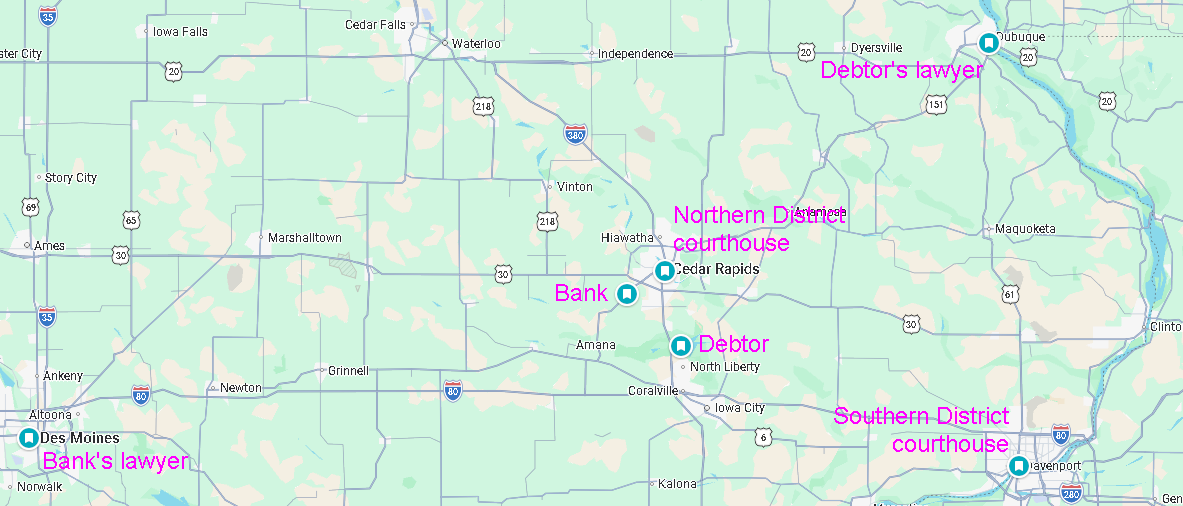
A person files for bankruptcy in the Northern District of Iowa. Among his debts is a 190&h;k$ loan from a bank. The Northern District&a;s nearest courthouse is 10 miles from the debtor&a;s house, 60 miles from the debtor&a;s lawyer, 10 miles from the bank&a;s headquarters, and 160 miles from the bank's lawyer (as measured by me “as the crow flies” in Google Maps; the measurements made by the judge in the opinion linked below are slightly different).
•
The bank points out that the person actually lives in the Southern District of Iowa, and moves for a change of venue. The Southern District&a;s nearest courthouse is 60 miles from the debtor&a;s house, 70 miles from the debtor&a;s lawyer, 70 miles from the bank&a;s headquarters, and 160 miles from the bank&a;s lawyer.
•
The bankruptcy judge&a;s “general practice is to retain improperly venued cases absent an objection from an opposing party”. He is frustrated by the bank&a;s motion here, since “all factors related to convenience and cost savings for all parties favor venue in this district” (emphasis in original), and “in other cases, like this one, the bank or its attorney appears to simply want to make things harder for the debtor”. But the statute gives him no discretion, so he cannot avoid transferring the case to the Southern District.
Summarized on 2026-08-07
•
Prominent publicly&h;traded mattress manufacturer Sleep Number has filed for bankruptcy, and has been taken private for 700 M$ by a Canadian mattress retailer. It claims that, of its 3000 employees, 38 bigwigs—including nine vice presidents and 13 directors—are important enough to the company&a;s operations that they need to be enticed to stay during the transition to new ownership. It proposes to do so by giving to each of these employees a retention payment of approximately 48 k$.
•
The bankruptcy trustee objects to this idea, claiming that these payments would constitute illegal distribution of assets to insiders. But the bankruptcy judge overrules the objection. Despite being called vice presidents and directors, these employees are not members of the Executive Leadership Team (which consists of six senior and executive vice presidents in addition to the CEO), and are not members or appointees of the board of directors. Therefore, the employees in question are not insiders, and the retention payments are perfectly fine.
Summarized on 2026-07-31
•
In year 2011, a tourism&h;reliant village with fewer than 3000 inhabitants (though, hilariously, it officially is called a “city”) enters into an agreement with a developer for the annexation and residential development of a 360&h;acre property in adjacent unincorporated land. However, disagreements arise. The development agreement allows the developer to start building anytime within the next 25 years at its sole discretion (since “the parties understood that the housing market was slowly recovering from the 2008 financial crisis and that the market was not ready for the project”). But, just eight years in, the village govt. expresses its opinion that the agreement that it signed is “outdated, one&h;sided, and incomplete”, and starts ignoring its provisions (e. g., an expedited permit&h;approval process). The developer is forced to file three separate arbitration proceedings in order to counter the village govt.&a;s reluctance to abide by the agreement. In the third proceeding, it finally asks for damages. The arbitrator finds that the village govt. has “persistently breached the development agreement”, and awards to the developer a “conservative damages calculation” of 22 M$ bearing interest of 12 %/a. (See document 81 page 6 for the arbitrator&a;s decision, document 81 page 1 for the developer&a;s viewpoint, and document 12 for the village govt.&a;s viewpoint) The village is unable to satisfy even the interest payments on this penalty, and files for bankruptcy.
•
The developer objects to the bankruptcy. It alleges that the village govt. did not file in good faith; rather, its problems arose entirely from its own bad&h;faith breach of the development agreement, and it made no attempt to reduce expenses or to increase revenues before filing for bankruptcy. However, the bankruptcy judge rejects the developer&a;s arguments. The village govt. engaged in multiple months of good&h;faith mediation with the developer, and filed for bankruptcy only after the mediation failed and the developer garnished the village govt.&a;s bank accounts. The village govt.&a;s breach of contract does not necessarily imply bad faith. And the judge refuses to follow a decision from a different bankruptcy court under which govt. bankruptcy is a last resort, available only after the govt. has tried to fix its budget by implementing austerity measures (which indeed may lead only to a “death spiral” rather than to an improved financial position).
Summarized on 2026-09-25
•
In May 2023, four condominium units are rendered uninhabitable by a fire. The condo company calls on its insurer for coverage. By July, the condo company and the insurance company agree that complete demolition and replacement are necessary.
•
In August 2023, there arises a dispute regarding whether the concrete slab needs to be included in the demolition and replacement. The insurance company's engineer prepares a report stating that concrete exposed to extremely high temperatures turns pink, indicating chemical changes that make it unsuitable for further structural use. The report includes two photographs (reproduced in the judge's opinion) that clearly show pink concrete in the slab. However, the engineer concludes that the slab need not be replaced! The condo company disagrees with this assessment.
•
In January 2024, the condo company's engineer conducts a core test on the slab. The test indicates that the slab does not have sufficient strength to support a replacement structure. In July 2024, the insurance company's engineer finally makes a second visit to the site and changes his opinion, and the insurance company increases its replacement-cost estimate from 0.96 M$ to 1.05 M$.
•
In December 2024, the condo company sues the insurance company for bad-faith conduct that delayed construction and thereby inconvenienced the displaced inhabitants. In January 2026, the insurance company moves for summary judgment to dismiss the condo company's claims, but in September the trial judge refuses to grant it: there is enough evidence for a jury to conclude that the insurance company was unreasonable in (1) blindly relying on its engineer's obviously internally inconsistent report and (2) not sending its engineer out for a second inspection until six months after the condo company's core test brought his report into even greater question. The parties settle a week before the scheduled trial date, presumably with the condo company getting the better end of the deal.
Summarized on 2026-09-18
2002
ICAONA (International Checkers Association of North America) is the only major checkers organization in the US.
2005
ICAONA becomes a member of FMJD (Fédération Mondiale du Jeu de Dames, World Draughts Federation), which conducts global checkers tournaments.
2024
Alexander Rudnitsky, five-time US checkers champion and former vice president of ICAONA, sets up NDF (National Draughts Federation of the USA) as a separate organization.
2024, Later
ICAONA claims that NDF forged the signature of ICAONA's president in applying for an NDF tournament to be FMJD-certified, and accuses NDF of trying to supplant ICAONA as the US member of FMJD. NDF denies both accusations. FMJD temporarily removes the NDF tournament from its calendar, but later adds it back after ICAONA withdraws its objection.
2025
Rudnitsky sues ICAONA on ten different counts. He alleges that, in addition to defaming him regarding the forgery, ICAONA conducted an illegal secret vote, changing its bylaws to force all US checkers players to be ICAONA members in order to be eligible for FMJD tournaments (which is a violation of FMJD bylaws).
2026
The judge dismisses one count (breach of contract), but says Rudnitsky wins summarily on six counts (including defamation, tortious interference, and antitrust)—not on the merits, but merely because ICAONA failed to substantively respond to them. Three counts (including infliction of emotional distress) remain to be decided at trial.
Summarized on 2026-09-16
•
A person is charged with a 2007 murder. In 2009 he is convicted, and in 2010 he is sentenced to life in prison. In 2015, his state habeas petition is rejected.
•
Also in 2015, he files a federal habeas petition. The Philadelphia prosecutor's office resists the petition in 2017, but in 2018 Larry Krasner is elected as prosecutor (district attorney) of Philadelphia, and in 2019 the prosecutor's office stops resisting. However, the federal proceedings are stayed until the defendant's second state habeas petition has finished being digested by the state judicial system.
•
In 2022, the federal proceedings finally start up again. Krasner's office concedes that the defendant's trial lawyer was ineffective for failing to object to a detective's hearsay statement (that a non-testifying witness told the detective that the defendant was the shooter). Since the proceeding no longer is adversarial, the judge invites the state prosecutor (attorney general) to intervene as amicus curiae.
•
In 2026, Krasner's office moves to withdraw its concession because the document contains “material misstatements”. The judge investigates. I'm not sure that I'm summarizing the sequence of events correctly, but I think it's something like this:
1
Matthew Stiegler, chief of the office's Conviction Integrity Unit (so presumably a direct subordinate of Krasner), looks at the case with the aid of the Innocence Project and the Defender Association of Philadelphia, and decides that it should be conceded.
2
He intentionally assigns the job of “writing” the concession—in reality, just copying-and-pasting whatever Innocence Project and Defender Association say, and not bothering to talk with the relevant witnesses—to inexperienced assistant prosecutor Jaclyn Mason.
3
After reading the concession document, the judge doesn't just swallow it, but instead demands a hearing to get sworn testimony from the relevant witnesses. This prompts a “panic” in the prosecutor's office.
4
Four assistant prosecutors go over the concession document again and find many “misstatements” (lies) in it. The four recognize that this is all Stiegler's/Krasner's fault, but Mason misinterprets them as assigning the blame to her, and submits her resignation to Krasner.
5
Krasner's chief of staff Jennifer Lin directs Mason to stop working immediately rather than staying until the end of the month, in order to make her resignation seem inculpatory to the judge.
6
Judge-written heading: “Stiegler Schemes to Blame Mason”. However, the four assistant prosecutors refuse to do this, and insist that this misconduct be referred to the state prosecutor. Krasner wants to "protect the office".
7
The four assistant prosecutors finally submit to the judge a document stating that Krasner, along with the entire prosecutor's office, has a conflict of interest and should be disqualified from participating in the case.
•
The judge doesn't like this rigmarole one bit.
The credible evidence is tantamount to a prima facie showing of conduct that may constitute false statements, false declarations made under oath, perjury, obstruction of justice, and conspiracy.
…
I have thus reluctantly concluded that Philadelphia's highest law enforcement official and one of his top assistants may have violated the law. In these circumstances, with the issuance of this Memorandum, I refer the DAO, Mr. Krasner, and Stiegler to this District's United States Attorney's Office for investigation and other appropriate action.
…
It appears that in attempting to impede the Court's hearing and inquiry into the DAO's conduct in Johnson, Mr. Krasner, aided by Stiegler, put the Law Division supervisors in an impossible situation that might jeopardize them professionally and may have violated the law. Mr. Krasner and Stiegler have thus created a basis for their disqualification from Johnson and their referral to the Department of Justice.
Summarized on 2026-07-17
•
A paraplegic is a “tester” of accessibility under the ADA (Americans with Disabilities Act): he visits, and then sues, businesses that fail to measure up to the ADA&a;s requirements (the ADAAG, ADA Accessibility Guidelines). His latest target (he testifies that it&a;s his 83rd) is a strip mall. He alleges: (1) Of the property&a;s two accessible parking spaces, one is immediately adjacent to a driveway, with no access aisle for safety; (2) of the property&a;s several curb ramps, one is too steep; (3) the sidewalk in front of the businesses is not sufficiently flat, making it difficult for a wheelchair user to open a business&a;s door without rolling backward into the parking lot; and (4) a different curb ramp often is blocked by parked cars.
•
The paraplegic demands that several changes be made. The trial judge rejects most of them (removal of bollards in the sidewalk, addition of two more accessible parking spaces, reduction of parking&h;lot slope, etc.): they are not “readily achievable” within the meaning of the ADA, as they would drive out tenants (by exacerbating the property&a;s existing parking shortage), jeopardize the property&a;s grandfathered status under the municipal code (it has only 88 parking spaces rather than the required 104), expose the company to liability (businesses have been sued for not having bollards), etc. The company implements one demanded change voluntarily before the case is even over, moving the accessible parking space without an access aisle to a safer location (right next to the other accessible parking space, so that they share an access aisle). The judge finds that the company must accede to one more demand: changing the too&h;steep curb ramp from perpendicular (protruding from the sidewalk into the access aisle) to parallel (taking a 3&h;foot&h;deep chunk out of the 8.5&h;foot&h;deep sidewalk in front of the businesses).
•
The company moves for a new trial, complaining that a parallel curb ramp (1) would be too expensive and too difficult to get permits for and (2) itself would violate the ADA, but the trial judge rejects these arguments. (1) The company has presented insufficient evidence of the expense of the modification or the difficulty of getting permits. (2) The company&a;s expert misread the ADAAG! He looked at the bathroom guidelines, under which door swings cannot encroach into required clear areas. But the sidewalk guidelines have no such provision, so the parallel curb ramp is fine. (The judge&a;s opinion includes helpful diagrams.)
Summarized on 2026-09-25
•
A real-estate company buys one of the three lots that constitute a shopping center. A different company owns the other two lots. The shopping center's parking is split between the first company's lot and the second company's lots. The first company tries to exert unilateral control over parking in its lot, and the second company sues. The state trial court rules that the second company has an easement over the first company's lot. The state appeals panel finds only an implicit license, not an explicit easement. (The state appeals panel's opinion is a bit too complicated for me to summarize, but it does have helpful diagrams of the three lots.)
•
The real-estate company demands that its title-insurance company reimburse it for the lost value of what it purchased, up to the policy limit of 1.2 M$. However, the insurance company claims that the lost value is only 33 k$. The real-estate company sues.
•
The real-estate company's expert claims that the lost value is 1.1 M$: without the parking encumbrance it was worth 2.5 M$ as the potential site of a mixed-use commercial and residential redevelopment, but with the parking encumbrance it cannot be redeveloped in that manner and therefore is worth only 1.4 M$ in its current commercial form. The insurance company's expert claims that the difference in value between a shopping center with an exclusive parking lot and a shopping center with a shared parking lot is only 33 k$. The jury agrees with the real-estate company's expert. The appeals panel affirms, finding little merit in the insurance company's arguments.
Summarized on 2026-08-21
While resisting arrest, a suspect bites a police officer&a;s penis hard enough to draw blood and require treatment at a hospital (though no more details are in the record). Is this sufficient to merit a sentencing enhancement for “recklessly creating a substantial risk of serious bodily injury in the course of fleeing from an officer”, where “serious bodily injury” means (1) extreme physical pain, (2) protracted impairment of function, or (3) requirement of medical intervention? This enhancement more often is applied to situations where the suspect leads officers on a high&h;speed car chase. But the trial judge says “yes”, and the appeals panel affirms.
The location of the bites, the officer&a;s penis, is crucial. Different parts of the body have different vulnerability to injury. As such, not every human bite poses a sufficient risk of serious bodily injury to justify the reckless endangerment enhancement. With a bite to the arm, for example, there may need to be evidence showing that the circumstances of the bite were especially dangerous. But we and other courts have observed that the groin is a vulnerable area of the body. Indeed, the penis is a particularly “sensitive [and] private body part”. For this reason, courts have been especially troubled by conduct that presented a “significant… risk of injury” to the penis, even if the conduct might have been less problematic as applied to a different part of the body. Here, Clay&a;s bites to the officer&a;s penis posed a much higher risk of serious bodily injury than if the bites had contacted a less vulnerable body part. So we conclude that the location of the bites, coupled with the fact that the bites were so forceful they caused at least some actual injury requiring medical treatment, supports the district court&a;s application of the enhancement.
Summarized on 2026-07-10
•
A food manufacturer experiences salmonella contamination at a peanut&h;butter factory. It is targeted by thousands of lawsuits, and calls on its insurer for coverage, since it expects to incur total damages in excess of its policy&a;s deductible of 250 k$ per “occurrence”, defined as “an accident, including continuous or repeated exposure to substantially the same general harmful conditions”. However, the insurer points out that a later section of the same policy redefines “occurrence” as “any ‘bodily injury’ or ‘property damage’ that arises out of any one ‘lot’ of ‘your product’ that is prepared or acquired by you”—i. e., each 24&h;hour lot of peanut&h;butter production counts as a separate occurrence. The contaminated peanut butter was distributed over 225 lots, so the 250&h;k$ deductible must be reached on the basis of a single lot—not all the contaminated lots combined—before the insurer will provide coverage on that single lot. The manufacturer sues the insurer in order to get a clarification of which definition of “occurrence” controls.
•
The trial judge rejects the insurer&a;s interpretation and adopts the manufacturer&a;s, and the appeals panel affirms. The later section of the policy is ambiguous as to whether it is intended to redefine “occurrence”, especially when compared with other sections that do explicitly specify that they are redefining previously&h;defined terms. Even when considered in a vacuum, the second definition is ambiguous in itself: it is not clear whether, under the second definition, multiple injuries caused by a single lot are one occurrence or multiple occurrences. And it is circuit precedent that any ambiguity in an insurance policy is to be construed against the insurer that wrote that policy.
Summarized on 2026-08-21
•
A company buys a “vacant, dilapidated, and uninhabitable building”, and a few months later submits to the municipal zoning commission a code&h;compliant plan for redevelopment into an apartment complex. However, the zoning commission refuses to even look at the plan! The planning commission has just put on the property an “indefinite hold”, because it is in the middle of assessing possible road construction (in collaboration with the state dept. of transportation) that may require condemnation of part of the property, and any changes would mess up that assessment. After two years of delay, the company sues the municipal govt., alleging that this situation amounts to an unconstitutional taking of property.
•
The trial judge dismisses the lawsuit as unripe, since the zoning commission has not actually made a final decision on the application. But the appeals panel reverses and remands. Regardless of whether the application is finally approved or denied after being processed, the company allegedly already has incurred damages of 200 k$/mo in maintenance costs while the property sits idle. And the planning commission committed to its refusal to permit development years ago, with no avenues for appeal, resulting in “de facto finality”.
Summarized on 2026-07-23
•
A black Muslim felon is indicted on dozens of federal fraud charges regarding his operation of a nonprofit. He conducts his defense, including voir dire and jury selection, pro se (without a lawyer).
•
The venue for this trial is Alameda County, California, where Harris took 75 percent of the votes (85 percent in the city of Oakland) in year 2024. A particular person is selected as an alternate juror. After taking the oath, he approaches the judge to express concerns that he will not be able to be impartial.
He began by saying, “I was hoping this wasn&a;t going to be an issue because I stayed engaged for all the hours and everything. And then the defendant spoke, and all that came out was discrimination, conspiracy theories, and police corruption.” He continued: “That just upsets me to no end, because being gay, trans, and non-binary, having bottles thrown at my head when exiting gay bars, being denied housing for being gay, when that&a;s the only thing [Colar] talked to us about, I&a;m sorry, that&a;s just festering in my head right now.” According to Juror 48, there was “no way [he was] going to be able to get that out of [his] head.” He also reacted to Colar&a;s claim that the prosecution was “turning a small thing into a big thing”: “So there is a thing. That&a;s just going to stick in my head the entire time.”
When the court reminded Juror 48 that his task was to evaluate the government&a;s evidence and decide whether the government met its burden of proof, he did not retreat from his views. He acknowledged that the court had discussed the need for jurors to be impartial. But he expressed strong disapproval of Colar&a;s invocation of “oppression, discrimination against Muslims and Africans, and police corruption all across the nation” as a defense to the charges. And he suggested that this factored into his ability to evaluate the evidence. “I&a;ve actually been discriminated against and I&a;ve actually had these issues,” Juror 48 said. “It just pisses me off that that&a;s being used as a scapegoat in an instance like this.” He added: “Literally the only things that [Colar] said were, were just those three things. Like, there was no substance.”
The defendant asks the judge to remove this alternate, but the judge refuses to do so. “I hear what [Colar] is saying about [Juror 48].… But—and he&a;s coming back Monday. I&a;ll tell you that much.… I&a;ll give it some consideration, and if I need to think about it further on Monday, I can.”
•
The next day, it turns out that one of the non-alternate jurors got into a car crash, so the alternate juror in question now will be on the jury if he isn't excused. However, on a second colloquy with the judge, the juror says he has changed his mind and can be impartial.
During the discussion, the court told Juror 48 that he was “now part of the jury” and asked him about the views he expressed on Friday. The juror said: “I let my emotions get the best of me on that one,” and described how Colar&a;s statements at voir dire “just brought up a lot of the bad issues that had happened in the past. So that little trauma from back then kind of came from nowhere.” He asserted that “over the past few days, I remembered exactly, like, there was a report I got afterwards, and I&a;m completely, like, past all that.” He added: “It was a little scratch in the back of my head that really bothered me at first. But, again, given a few days, I&a;m perfectly over it now. I&a;m fine.” The court asked him if he had any concerns about his ability to be fair and impartial, follow instructions, and evaluate the evidence. The juror replied, “No, I don&a;t.”
Colar then spoke to Juror 48. He said, “[Juror 48], I believe that you should be excused, and the reason why is because you did state your bias.… What&a;s making you change your mind now?” Juror 48 responded, “When you were speaking during the jury selection, it had brought up some past traumas.… I have overcome those things in the past with the support of my friends and my family. I just had to remember that over the weekend….” He continued, “I promise, I am not going to be biased,” and “I was able to calm my head back down.” When Colar pressed him on what specifically triggered the reaction, the juror reiterated that “it&a;s the fact that the entire thing, the entire time you were talking,… all I was hearing from you was that there was discrimination, that they were against people of the Islamic faith, things like that, and that kind of just got stuck in my head.”
The defendant again asks the judge to remove the juror, but the judge again refuses to do so.
The district court asked no further questions and found Juror 48 fit to serve. Colar maintained his objection, stating, “I don&a;t believe that he can put that aside.… If something else comes up that I say and it re-triggers [him],… I don&a;t think he can put it to the side.” The court replied: “It&a;s… the position that… one would obviously take in your shoes and I understand it, and it is preserved for the record on appeal.”
•
The defendant is convicted on all charges, and appeals. The appeals panel reverses and remands.
A juror&a;s initial expression of bias can be overcome if, upon further inquiry, he unequivocally commits to setting it aside and deciding the case based on the evidence presented. Juror 48 eventually told the court that he was “perfectly over” his earlier reaction and had no concern about his ability to be impartial. Still, for two reasons, the district court abused its discretion in finding Juror 48 fit to serve and failing to excuse him for cause under an actual bias theory.
First, a juror&a;s assurances must be measured against the whole record, with any remaining doubts resolved against the juror. Juror 48 attributed his change of heart to having “time to calm down” and remembering how to “overcome it.” That described a shift in his current emotional state, not a reassessment of the conclusions that he had drawn. The court did not ask whether he still believed that there was “a thing” or that the defense theory lacked merit, the very views that made Juror 48&a;s statements so serious. A bare promise by Juror 48 that he was “not going to be biased” did not, in context, unequivocally assure his impartiality.
Second, Juror 48&a;s bias was tied to a defense theory that would recur. As the government admits, racial and religious targeting was “a theme of Colar&a;s defense” throughout his trial. That theme triggered Juror 48&a;s prejudicial reaction. In his continuing objection, Colar raised the concern that “if something else comes up that I say and it re-triggers… his emotions, [] I don&a;t think he can put it to the side.” Yet the court never asked Juror 48 that critical question: whether hearing the defense theory throughout the remaining weeks of trial would retrigger his emotions and impair his ability to serve impartially.
…
The district court abused its discretion by failing to promptly investigate Juror 48, deferring inquiry until a seat opened, and conducting an inadequate colloquy after the juror had heard evidence. The record as a whole was unclear as to whether Juror 48 unequivocally committed to setting aside his bias, and this doubt should have been resolved against him. The court&a;s failure to excuse him was an abuse of discretion. These errors ultimately deprived Colar of his Sixth Amendment right to an impartial jury. We vacate Colar&a;s convictions and reverse and remand for a new trial.
Summarized on 2025-03-06
Scenario 1
The state DEP (Department of Environmental Protection) gives to the state DOT (Department of Transportation) a permit saying that DOT can&a;t pave near floodways, because that might cause flooding. DOT obeys the paving restriction. Even if flooding occurs later on (due to the actions of some entity other than DOT, or due to changes in precipitation patterns), DOT cannot be punished by DEP for that flooding, because it obeyed the restrictions of the permit. (I&a;m not quite sure what form such punishment would actually take. Are different arms of the same government allowed to impose fines on each other?)
Scenario 2
DEP gives to DOT a permit saying that (1) DOT can&a;t pave near floodways, because that might cause flooding, and (2), if flooding occurs, DOT will be punished. DOT obeys the paving restriction. If flooding occurs later on (due to the actions of some entity other than DOT, or due to changes in precipitation patterns), DOT can be punished by DEP for that flooding, even though it did nothing wrong.
Scenario 2 sounds ridiculous, right? Well, keep reading.
Scenario 3
The federal EPA (Environmental Protection Administration) gives to San Francisco a permit saying that SF can&a;t discharge untreated sewage into the ocean, because that might cause the ocean to become polluted. SF obeys the discharge restriction. Even if the ocean becomes polluted later on (due to the actions of some entity other than SF, or due to changes in ocean currents), SF cannot be punished by EPA for that pollution, because it obeyed the restrictions of the permit.
Scenario 4
EPA gives to San Francisco a permit saying that (1) SF can&a;t discharge untreated sewage into the ocean, because that might cause the ocean to become polluted, and (2), if the ocean becomes polluted, SF will be punished. SF obeys the discharge restriction. If the ocean becomes polluted later on (due to the actions of some entity other than SF, or due to changes in ocean currents), SF can be punished by EPA for that pollution, in the amount of multiple billions of dollars, even though it did nothing wrong.
The Supreme Court now has ruled, by a bare majority of five to four, that the Clean Water Act does not authorize the EPA to issue the permit that is described in scenario 4. More specifically:
•
The text of the Clean Water Act passed by Congress says that a permit can contain, not just “effluent limitations”, but also “any more stringent limitation that is necessary to meet the water&h;quality standards”. “Effluent limitations” obviously permits scenario 3. The question before the Supreme Court is whether “any more stringent limitation” permits scenario 4.
•
The five&h;justice majority decided that, in this context, when Congress wrote “limitation” into the Clean Water Act, it meant that the EPA needed to tell San Francisco specifically what to do in order to avoid penalties (e. g., “your discharge into the ocean must not be polluting”), rather than just vaguely gesturing (e. g., “the ocean must not become polluted while you are discharging into it”).
•
The four-justice minority disagrees with this assessment, and thinks that the word “limitation”, regardless of context, can permit the EPA to make San Francisco responsible for the water quality of the ocean, rather than just for the water quality of what it discharges into the ocean.
A doctor could impose a “limitation” on a patient&a;s diet by telling the patient that she must lose 20 pounds over the next six months, even if the doctor does not prescribe a specific diet and exercise regimen. “Limitations” can be general as well as specific, and general limitations can call for more specific ones.
Summarized on 2026-07-03
•
A person&a;s house is assessed at “market value” of 194 k$. The county govt. seizes it over 2 k$ of unpaid property taxes, sells it at auction for 76 k$, and returns the excess 74 k$ to the person. The person sues the county, claiming that he should have gotten 192 k$ (assessed value minus tax delinquency) rather than 74 k$ (auction proceeds minus tax delinquency).
•
The trial judge, the appeals panel, and the federal Supreme Court reject this argument. If the auction was conducted in a fair manner, then by definition it revealed the true “market value”, and using the speculative assessor valuation instead would be unreasonable. However, the Supreme Court remands for the appeals panel to check whether the auction actually was conducted in a fair manner, especially since the company that bought the property at auction sold it again for 195 k$ just a year and a half later.